Preserving Bolognese: how to keep it delicious for a long time
A good Bolognese takes time, but you can easily prepare it in large quantities.
Bolognese can then be boiled down to preserve it for a long time without losing its flavor.
Bolognese can be cooked in small jars and stored in this way for around 9 months. It is important to store the jars in a cool, dark place, usually the cellar is best for this. This method is excellent for preserving the quality of the sauce.
In this article, you will find out how to cook Bolognese sauce properly and what you need to bear in mind.

Cooking bolognese – how it works
Before you start, please read the following paragraph.
What is important to bear in mind when preserving?
Canning is all about preserving homemade Bolognese for as long as possible. To make this possible, it is important to pay particular attention to hygiene during the entire process:
- Only use fresh minced meat and always keep it refrigerated in the meantime.
- Work on a clean work surface, wash your hands regularly and use clean materials (pot, knife, pan, spoon).
- Disinfect the jars, rubber rings and tools that come into contact with the food. The storage jars in particular must be sterile before filling. Only touch them from the outside or with tongs.
These points are essential, as minced meat is usually very susceptible to microorganisms and all the effort would be in vain if the product goes bad.
For more information, you can read the following AOK article on preserving food.
Step 1: Finish cooking the Bolognese
Before you can cook bolognese, you must first prepare it completely. It is best to add it immediately (while still hot).
If the bolognese has already cooled down, you can still boil it down, but do not use hot water in step 3 (so that the jars do not burst due to the high temperature difference).
Step 2: Pour the Bolognese into jars up to 2 centimetres below the rim
Use tall jars for cooking bolognese and test whether they all fit in the pot. They should be the same height and size and roughly the same format as this set:
Fill the jars with the hot Bolognese, but make sure you leave at least 2 centimetres of space between the sauce and the edge of the lid. The remaining air will escape later when cooling and create a vacuum.
Step 3: Seal the jars and place in the preserving pot
Seal the jars and place them upright in the pot. You can use a clean cloth and spread it out on the bottom of the pot to prevent the jars from cracking due to the temperature difference.
Step 4: Add hot water so that a quarter of the jars stick out
Empty the water into the pan with the jars of Bolognese. The water should be about the same temperature as the Bolognese. As I fill them while they are still hot, I use warm but not boiling water (about 70 degrees).
Step 5: Boil for 75 minutes at 100 °C
Bring the water in the pan to the boil (100 °C) and then set a timer for 75 minutes. During this time, the heat will kill all possible germs.
Step 6: Remove the pan from the heat and leave the jars to cool
Once the timer has gone off, you can remove the pan from the heat and leave to cool. The process is now complete.
It is also worth labeling the jars with the exact contents and production date, because as soon as you open them, the cooked bolognese must be eaten within 2 days (if kept refrigerated).
Step 7: Store the cooked bolognese in a cool, dark place
The cooked Bolognese must be stored in a cool place away from light. A cellar is usually the best place for this.
Frequently asked questions
How does canning work?
When boiling down, the finished Bolognese sauce is filled into jars and cooked for over an hour. This not only kills any germs, but also allows air to escape from the jars and creates a vacuum when it cools, which protects the Bolognese from spoiling.
How long does the preserving process take?
Once the Bolognese is cooked, it must be decanted and cooked for a further 75 minutes. The entire process, from the preparation of the Bolognese to the finished product, can be expected to take around 4 hours. Most of the time, however, the sauce just needs to simmer.
How much can you boil down at once?
How much you can cook in one go depends on the size of the pot and the jars. You can easily divide 1.5 kilograms of Bolognese between 3 jars, each with a capacity of 750 milliliters. With a wide pot and the right jars, you can usually double the amount.
Which bolognese can be cooked?
You can make vegetarian Bolognese with lentils or tofu as well as classic Bolognese sauce with minced meat. If minced meat is included, it should be particularly fresh. In all cases, particular attention must be paid to hygiene during the cooking process.
Alternative to boiling down: Freeze the Bolognese
Cooking Bolognese sauce involves certain risks, but only if everything is done correctly is a good shelf life guaranteed.
It’s also quite time-consuming to cook, so I prefer to freeze the bolognese instead.
You can find more tips and tricks for preserving Bolognese in my article Storing Bolognese.
You can find out how to reuse the Bolognese without risk after cooking or freezing it in my article Reheating Bolognese.
More articles on the subject of Bolognese
- The real Bolognese (original recipe from Bologna)
- Lasagne Bolognese (original recipe from Bologna)
- Bolognese cooking time: How long does Bolognese need to cook?
- Bolognese: What can and can’t go in it? (official recipe)
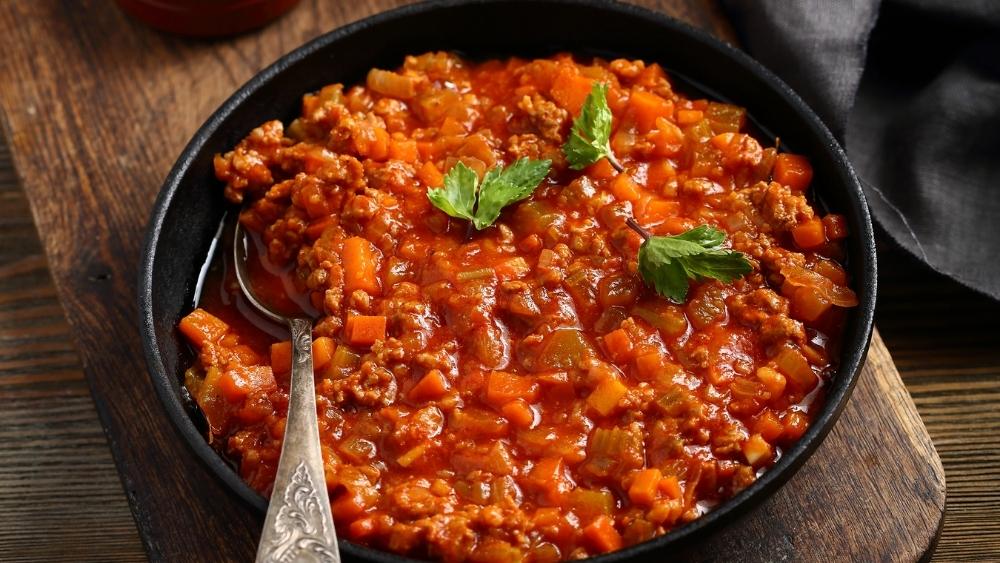
How can I tell if the cooked bolognese is still good?
One way to tell whether cooked bolognese is still good is if the vacuum created during cooking is still present. This can be seen when you open the jar: if you hear a hissing or cracking sound, the Bolognese is probably still good.
If the lid of the preserving jar is only loose, there is air inside. In this case, the Bolognese is no longer edible.
Secondly, you can carry out an odor and taste test. If the sauce smells or tastes sour or unfamiliar, the meat is spoiled and must be thrown away.
How do you use cooked bolognese?
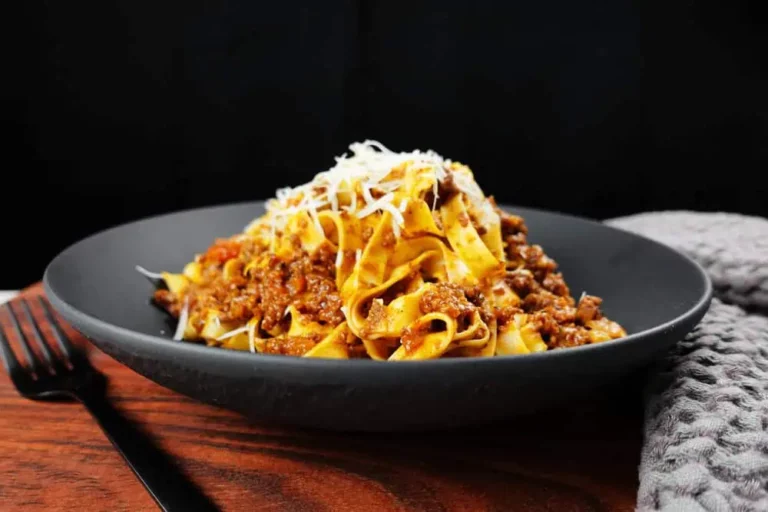
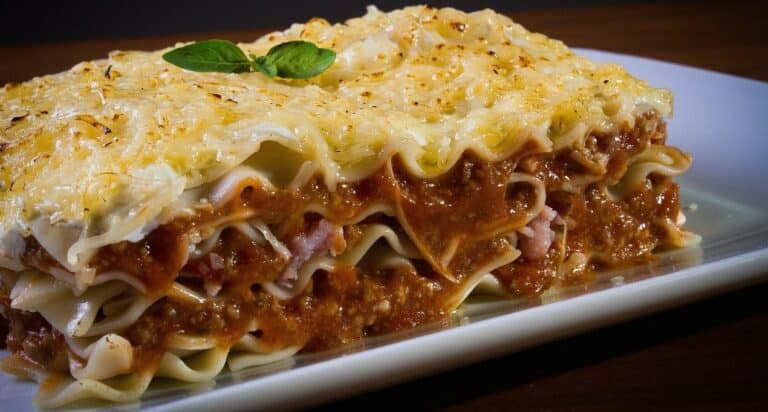
The cooked Bolognese sauce can be used for various dishes such as pasta with Bolognese, Bolognese lasagne or even homemade tortellini with a Bolognese filling.
All you have to do is heat them in a pan for at least 5 minutes at 70 °C or higher.